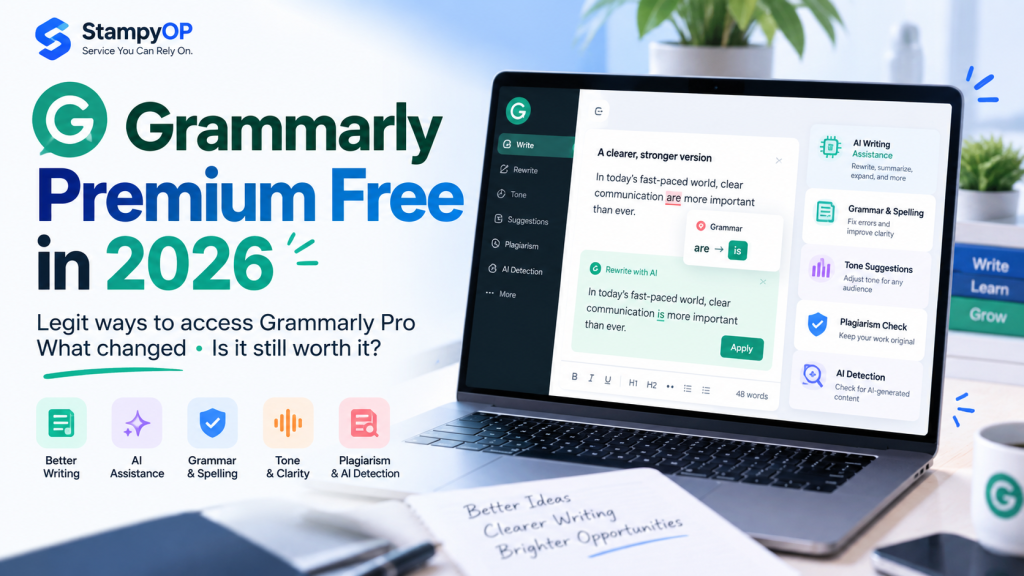
If you searched for “Grammarly Premium free,” you probably want one of two things: a legitimate way to try the paid features without paying immediately, or a clear answer on whether Grammarly is even worth using anymore now that ChatGPT and other AI tools can rewrite almost anything.
Both are fair questions. Grammarly in 2026 is not the same product people remember from a few years ago. The old Premium plan has largely shifted to Grammarly Pro on the web, the company behind Grammarly is now part of the broader Superhuman brand, and the product has moved far beyond simple spelling and grammar correction.
| A quick note if you are here for access
I sometimes share a working Grammarly Pro access on this page when one is available. If that is what you came for, save this page and check back from time to time. I update the access section separately, so availability can change without the rest of this guide changing. |
| Quick answer
Grammarly Premium is not completely gone. It still exists through the App Store and Google Play, while Grammarly Pro is the main paid web plan. Grammarly Free remains genuinely useful, Pro adds advanced rewrites, tone tools, plagiarism and AI-text detection, and a much larger AI allowance. Official Pro trials are offered periodically to eligible users. |
What happened to Grammarly Premium?
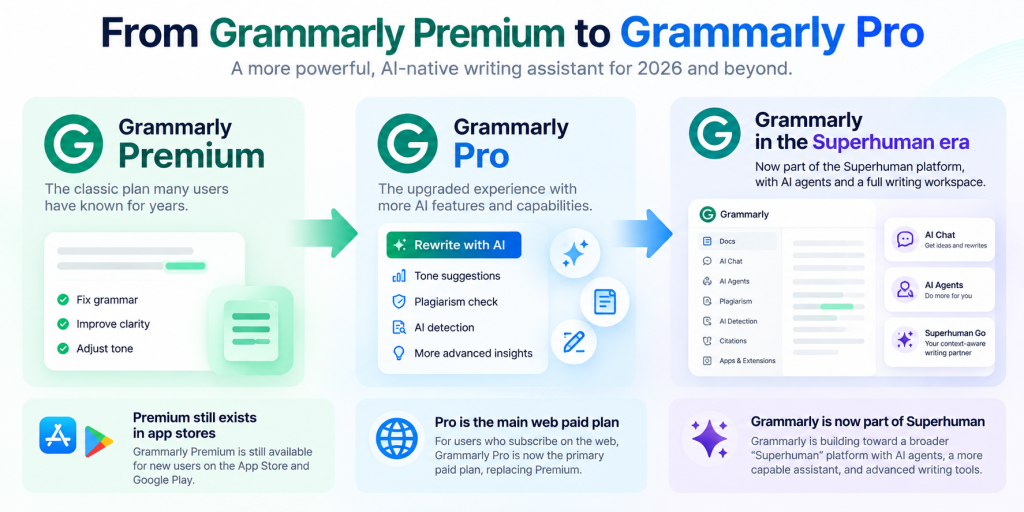
The naming is confusing because “Grammarly Premium” still appears in searches, older reviews, mobile app stores, and years of blog content. But if you subscribe to Grammarly on the web today, the paid plan you will normally see is Grammarly Pro.
According to Grammarly’s current support documentation, Premium remains available through the App Store and Google Play. That version keeps the core paid writing features and includes 1,000 generative AI prompts per month. Grammarly Pro is the broader web-purchased plan: it includes the core paid features, 2,000 generative AI prompts per month, and team-oriented functionality for users who need it.
There is another change that is easy to miss: in October 2025, Grammarly announced that its company name had become Superhuman. Grammarly itself did not disappear. The writing assistant is still Grammarly, but it now sits inside a bigger AI productivity suite alongside Superhuman Go, Docs, Mail and Coda-related workflows.
Premium is still a familiar search term, but Pro is the main web paid plan in 2026.
What is Grammarly in 2026?
Calling Grammarly a “grammar checker” is still correct, but it is incomplete. The traditional Grammarly experience is still there: spelling, punctuation, grammar, clarity and tone suggestions appear while you write. The bigger change is that Grammarly is now trying to help across the entire writing workflow, not only at the proofreading stage.
The current product includes a new AI-native Docs surface, AI Chat, specialized agents, full-sentence rewrites, plagiarism checking, AI-generated text detection, citation help, multilingual support and a growing connection to Superhuman Go. Go is designed to work across apps and tabs, bring context into the task you are doing, and let specialized agents help without forcing you to copy and paste everything into a separate chatbot.
That means Grammarly’s value proposition has changed. A few years ago, the reason to pay was mostly “catch more mistakes and improve style.” In 2026, the question is closer to: “Do I want a writing-focused AI layer that follows me through email, documents, browser text boxes and longer writing tasks?”
Did the AI revolution make Grammarly better?
In terms of capability, yes. Grammarly is much more powerful than it was before generative AI went mainstream. But “more powerful” does not automatically mean “better for everyone.” The product is broader, more ambitious and sometimes more complex than the simple red-underline experience people originally loved.
What is clearly better now
- Full-sentence rewrites are more useful than old one-word corrections. You can reshape a sentence for clarity, tone or impact instead of fixing it piece by piece.
- Tone control is more practical. Grammarly can help make a message sound more direct, warmer, more confident or more professional without forcing you to rewrite the whole thing yourself.
- The paid plan combines proofreading with originality tools. Pro includes plagiarism detection and AI-generated text detection alongside writing suggestions.
- AI assistance is built into the writing workflow. You can brainstorm, rewrite and get contextual help without constantly moving text between separate tools.
- Docs and AI agents extend Grammarly beyond proofreading. The new writing surface and agent system can help with research, feedback, reader reaction and other stages of writing.
- The AI allowance is much larger on Pro. Grammarly currently lists 100 AI prompts per month on Free and 2,000 per member per month on Pro.
Where the new Grammarly can feel worse
The tradeoff is simplicity. If all you want is a quiet grammar checker, you may not care about agents, connectors, AI chat or a broader productivity suite. More features also mean more UI, more decisions and more opportunities for an AI suggestion to be technically polished but not actually sound like you.
That is why human judgment still matters. Grammarly can improve the surface quality of a sentence, but it cannot guarantee that your argument is correct, your facts are true, or your writing sounds authentic. The best use is still as an editor and assistant, not an unquestioned final authority.
Does Grammarly still matter after ChatGPT?
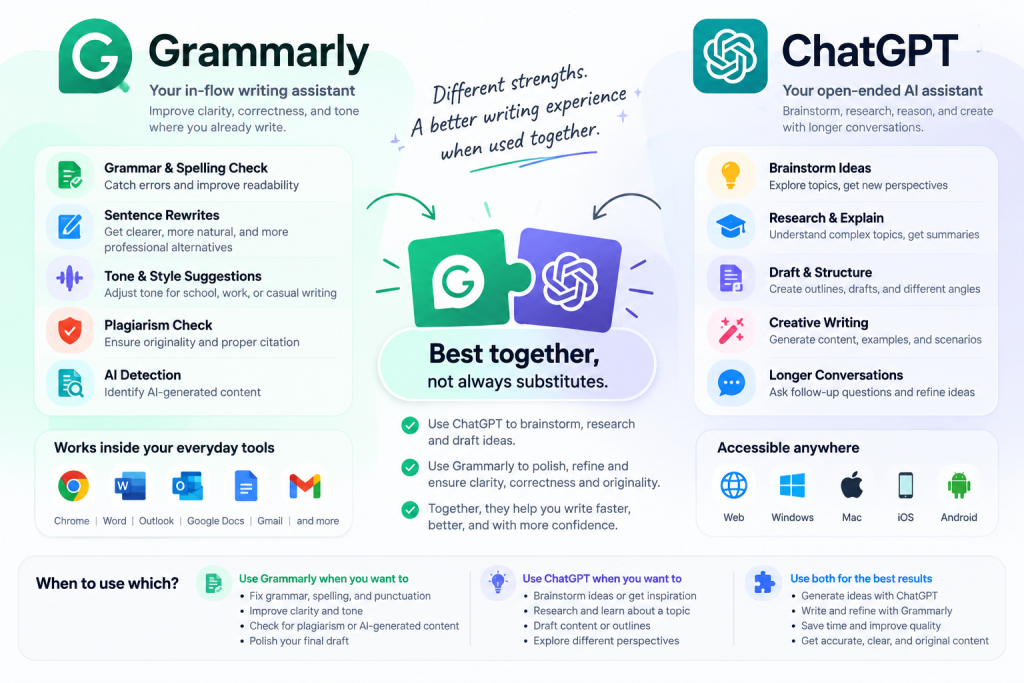
Yes, but for a different reason than before. ChatGPT, Claude and Gemini are excellent when you want open-ended brainstorming, explanations, research help, long-form drafting or a conversation that keeps evolving. Grammarly’s strongest advantage is that it lives inside the act of writing itself.
If you are writing an email in Gmail, a report in Word, a post in a browser or a paragraph in Docs, Grammarly can catch a problem in context and suggest a fix immediately. You do not always need to stop, open another tab, paste the text, explain what you want and paste the answer back.
So I would not treat Grammarly and ChatGPT as perfect substitutes. For many people the best workflow is simple: use a general AI assistant when you need ideas, research or a first draft, then use Grammarly to tighten the final writing, improve clarity, adjust tone and catch mistakes before you send or publish it.
Grammarly Free vs Grammarly Pro in 2026
Grammarly Free is better than many people assume. If your main goal is to stop obvious grammar and spelling mistakes, see basic tone feedback and occasionally use AI assistance, the free plan may be enough. Pro becomes easier to justify when writing quality affects your grades, job, clients, applications or public work.
Grammarly and ChatGPT overlap, but their strongest use cases are still different.
| Feature | Free | Pro |
| Price | $0 | $30 monthly / $60 quarterly / $144 yearly |
| Grammar & spelling | Yes | Yes |
| Tone visibility | Yes | Yes + advanced tone adjustment |
| Full-sentence rewrites | Limited / basic experience | Yes |
| Plagiarism detection | No | Yes |
| AI-generated text detection | No | Yes |
| Generative AI prompts | 100 / month | 2,000 / month |
| Best for | Everyday light writing | Frequent, academic or professional writing |
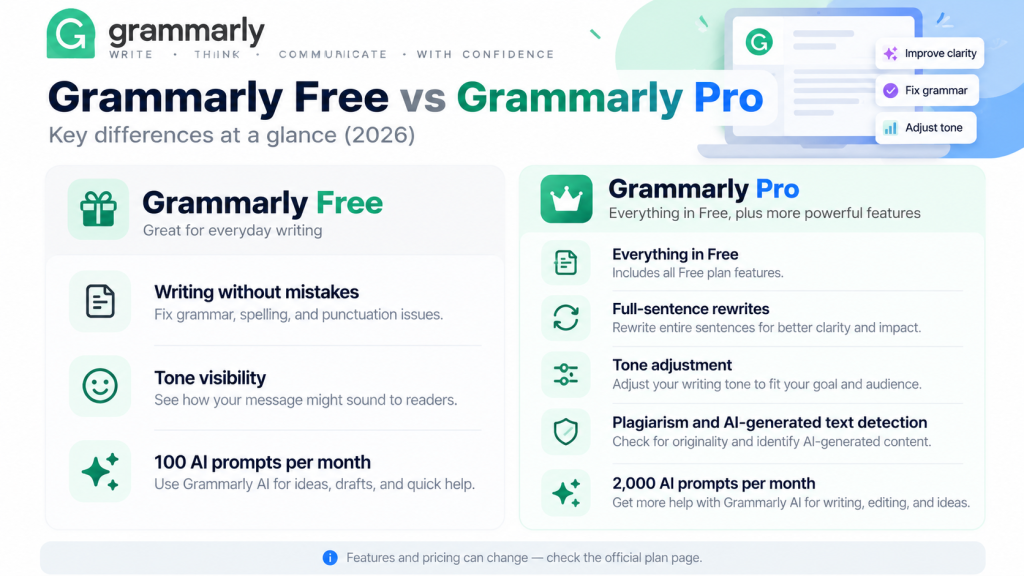
Free covers the basics; Pro is mainly about deeper rewriting, originality tools and heavier AI usage.
Grammarl/y Pro Account
| m@il | P@$$ | Last Update | |
|---|---|---|---|
| minichini0101@gmail.com | StampyOPisBack26! | 07-Oct-26 | |
Access can change at any time. If the account is unavailable, please check this page again later for the latest update.
Need Grammarly Pro Access or Help?
If the account above is unavailable, check our current Grammarly plans on StampyOP or join our Discord for the latest availability, updates, and support.
Want to see what other customers say? Read our customer reviews.
Legit ways to access Grammarly Pro for free
There is no permanent official “free Pro forever” plan. If a page promises lifetime Grammarly Pro through a crack, fake referral trick, stolen login or browser hack, that is not a reliable way to use the service and can disappear at any time. The legitimate options are much simpler.
- Start with Grammarly Free
The Free plan costs nothing and is enough to understand whether you even like Grammarly’s style of suggestions. It currently includes core spelling and grammar help, tone visibility and 100 generative AI prompts per month. For short emails, messages and everyday writing, that may be all you need.
- Check whether an official Pro trial is available
Grammarly says it periodically offers free trials of Pro to eligible individual users and teams. When a trial is available to you, the option appears on Grammarly’s website before you upgrade. Trial availability changes, so I would not rely on an old blog post that promises a fixed seven-day or fourteen-day trial for everyone.
- Check school or workplace access
Universities, schools and employers can buy institutional Grammarly plans. If your organization already provides access, use that before paying for a separate individual plan. It is also usually the better option for work or academic environments where privacy, administration and account ownership matter.
- Check this page when access is available
As mentioned near the top, I sometimes update this page with a working access option when I have one available. That section is maintained separately from the review, so bookmark the page if that is what you are mainly looking for. Always read the current notes next to the access before using it.
How much does Grammarly Pro cost in 2026?
Grammarly’s current official support page lists Pro at $30 per member when billed monthly, $60 for three months, or $144 per year. The annual option works out to an average of $12 per month. Regional pricing and promotions can vary, and the public plans page can show a $0 trial to eligible users.
| Pricing changes over time
Treat those numbers as a current snapshot, not a permanent promise. Check Grammarly’s official plans page before buying because trials, regional prices and bundle offers can change. |
Who actually needs Grammarly Pro?
The easiest way to decide is to stop asking whether Pro is “better” and ask whether the paid features solve a problem you have often enough to matter.
- Students: useful when you write essays, reports, applications or research-heavy work and want stronger rewrites plus plagiarism checking. You still need to follow your school’s AI and academic-integrity rules.
- Professionals: useful if emails, reports, proposals, client communication or leadership updates are part of your job and tone mistakes can cost you credibility.
- Non-native English writers: often one of the strongest use cases because Grammarly can help with fluency, clarity, sentence structure and tone while you work.
- Bloggers and content creators: useful for polishing drafts, reducing awkward phrasing and checking the final version before publication.
- Job seekers: helpful for resumes, cover letters, LinkedIn messages and application emails where small writing errors can create a bad first impression.
- Occasional writers: usually do not need Pro. Grammarly Free plus a general AI assistant may already cover enough of your needs.
How accurate is Grammarly?
Grammarly is useful, but it is not 100% accurate and it should not pretend to be. Language is contextual. A sentence can be grammatically correct but intentionally unusual, technical, sarcastic or stylistic. AI-generated rewrites can also flatten personality or subtly change meaning.
The safest habit is to treat every suggestion as a recommendation, not a command. Accept the corrections that clearly improve your writing, ignore the ones that change your voice, and verify factual claims separately. The same caution applies to AI-text detection: use it as a signal, not as proof of authorship.
The strongest Grammarly features in 2026
- Real-time grammar, spelling and punctuation checks across many common writing environments.
- Clarity and full-sentence rewrites that can improve awkward wording quickly.
- Tone detection and tone adjustment for different audiences and situations.
- Plagiarism checking for accidental overlap and originality review.
- AI-generated text detection as an additional review signal.
- AI Chat and agent-based help inside Grammarly’s newer Docs / Superhuman workflow.
- Multilingual support and translation-oriented writing help across more languages than the old English-only experience.
- A “works where you write” workflow that can be faster than moving every small edit into a separate chatbot.
Grammarly Pro pros and cons
| Pros | Cons |
| ✓ Excellent everyday proofreading | • Expensive if you only write occasionally |
| ✓ Strong rewrite and tone tools | • AI suggestions can sound generic |
| ✓ Works inside common writing workflows | • More complex than the old simple Grammarly |
| ✓ Plagiarism + AI-text detection in Pro | • No writing assistant can verify every fact |
| ✓ Much larger AI allowance than Free | • AI detection should not be treated as proof |
| ✓ Useful for school, work and job applications | • Free may already be enough for light users |
Best Grammarly alternatives in 2026
Grammarly is not automatically the best writing tool for every job. If one part of Grammarly matters more to you than the rest, a specialist tool may be a better fit.
| Alternative | Best for | Why consider it |
| ChatGPT | Brainstorming, research, drafting | More open-ended; better for long conversations and idea development |
| QuillBot | Paraphrasing and rewriting | Good when rephrasing and sentence variation are your main needs |
| ProWritingAid | Long-form editing | Detailed style feedback and reports for authors and longer documents |
| LanguageTool | Multilingual grammar checking | Useful if you regularly write in several languages |
| Hemingway | Readability and simplicity | Helpful for finding dense, hard-to-read sentences |
Is Grammarly Pro worth it in 2026?
For heavy writers, yes—more than it was a few years ago. Grammarly Pro now bundles advanced proofreading, rewriting, tone, originality tools and a large AI allowance into one workflow. If you constantly write things other people will judge, the time saved can be worth more than any single feature.
For light users, the answer is probably no. Grammarly Free is useful, general AI tools are widely available, and you should not pay $144 a year just because “Pro” sounds better. Upgrade when the paid features solve a repeated problem, not because a review tells you everyone needs them.
The biggest change since the old Grammarly Premium era is that Grammarly is no longer competing only with grammar checkers. It is competing for a place in your AI workflow. Its best argument is not that it can do everything ChatGPT can do. Its best argument is that it can improve the writing you are already doing, in the place you are already doing it.
Frequently asked questions
Is Grammarly Premium now Grammarly Pro?
For web purchases, Grammarly Pro is now the main paid plan and has replaced the old web Premium / Business positioning. Grammarly Premium still remains available through the App Store and Google Play.
Can I get Grammarly Pro for free?
Grammarly has a permanent Free plan and periodically offers Pro trials to eligible users and teams. Trial availability changes, so check the official upgrade page rather than relying on an old fixed trial promise.
How many AI prompts do I get?
Grammarly currently lists 100 generative AI prompts per month on Free, 1,000 on Premium, and 2,000 on Pro.
Does Grammarly Pro include plagiarism checking?
Yes. Grammarly Pro currently includes plagiarism detection and AI-generated text detection.
Is Grammarly still useful if I already use ChatGPT?
Yes, if you value real-time writing feedback inside your normal apps. ChatGPT is stronger for open-ended conversation and ideation; Grammarly is often faster for in-flow editing and final polish.
Is Grammarly good for students?
It can be very useful for clarity, grammar and originality checks, but students should always follow their school’s rules on AI-assisted writing and academic integrity.
Is Grammarly AI detection always correct?
No. Treat AI detection as a signal, not definitive proof. False positives and false negatives are possible with any detector.
Should I pay for Pro if I only write occasionally?
Probably not. Start with Free and upgrade only if the advanced rewriting, originality tools or higher AI allowance solve a problem you repeatedly have.
Final verdict
Grammarly is a better product than the old Premium version in terms of raw capability. It can still do the basics extremely well, but it now adds serious rewriting, AI assistance, originality tools, Docs, agents and a broader Superhuman workflow. The downside is that it is no longer the wonderfully simple product it once was.
If you are curious, start with Grammarly Free. If an official Pro trial appears, use it before paying. If you write every day and care about clarity, tone and final polish, Pro can still be one of the most convenient writing tools available. And if you came to this page mainly looking for a current access option, save the page and check the access section from time to time—I update that separately when something is available.
Looking for Grammarly Pro?
Check the latest StampyOP options for current availability, or join our Discord if you have a question before ordering.